- Car Loans
- Home Loans
- Personal Loans
- Business Loans
- Helpful Resources
-
-
- Loan Calculators ❯ Get My FREE Property Report ❯ Get My Credit File ❯ Send My Bank Statements ❯ Blog ❯ Personal Loan calculator
-
-
First Home Buyer Grants & Deposit Schemes in Australia (2026 Guide)
By Mary Nebotakis, Managing Director, Natloans, B. Eco, Dip. Financial Services
For many Australians, buying a first home has felt increasingly difficult over recent years — largely due to rising property prices and the challenge of saving a full 20% deposit.
However, 2026 may be one of the most accessible years in a decade to enter the property market.
Recent updates to government housing support programs, shared-equity initiatives, and low-deposit home loan options mean many buyers can now purchase a home significantly sooner than they expected — sometimes years earlier.
This guide explains the key first home buyer incentives available in Australia and how they may reduce both your upfront costs and ongoing repayments.
Why the Deposit Is the Biggest Barrier
Traditionally, lenders prefer a 20% deposit to approve a standard home loan without additional costs.
For a $700,000 property, that means saving $140,000 — which is often the main reason buyers delay purchasing.
If a buyer has less than 20%, lenders usually charge Lenders Mortgage Insurance (LMI).
LMI does not protect the borrower — it protects the lender — and it can cost $15,000–$35,000+ depending on the purchase price and deposit size.
Government housing programs are designed specifically to solve this problem.
The Home Guarantee Scheme (5% Deposit Home Loan — No LMI)
The Home Guarantee Scheme (HGS) allows eligible buyers to purchase a property with a low deposit while avoiding LMI.
Under this program, the government guarantees part of the loan, which reduces the lender’s risk and allows them to approve higher loan-to-value ratio (LVR) lending.
Key Features
-
Minimum 5% deposit required
-
No Lenders Mortgage Insurance payable
-
Owner-occupied properties only
-
Available through participating lenders
-
Government guarantees part of the mortgage
For eligible single parents or guardians, deposits may be as low as 2% under specific streams of the program.
For many buyers, this alone can reduce upfront costs by tens of thousands of dollars and bring forward a purchase timeline by several years.
Property Price Caps
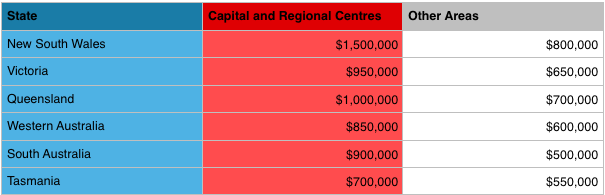
Eligibility also depends on property value caps, which vary by city and region. These caps are designed to keep the scheme focused on entry-level housing.
The Help to Buy Scheme (Shared-Equity Home Purchase)
One of the most significant housing initiatives being introduced is the Help to Buy Scheme.
Unlike the Home Guarantee Scheme, this is a shared-equity program — meaning the government contributes part of the purchase price in exchange for a proportional share of the property’s future value.
How It Works
-
Minimum deposit: 2%
-
Government contributes up to 30% (existing homes)
-
Up to 40% contribution for new builds
-
You live in and own the property
-
Government shares in future capital gain or loss
-
Owner-occupied homes only
Because the government contributes equity, your loan amount is smaller, which usually results in lower mortgage repayments and improved borrowing capacity.
Income Eligibility
-
Singles: up to $100,000 income
-
Couples or single parents: up to $160,000 combined income
This scheme is not strictly limited to first home buyers, although it is primarily targeted toward them.
Other First Home Buyer Incentives Available
Several additional programs can further reduce upfront costs.
First Home Owner Grant (FHOG)
A one-off government grant for buyers who build or purchase a new home.
Grant amounts vary by state and territory and may reach up to $30,000 in certain areas.
First Home Super Saver Scheme (FHSSS)
Allows voluntary superannuation contributions to be withdrawn for a home deposit.
Because contributions are taxed at concessional super rates, many buyers accumulate savings faster than through a standard savings account.
Stamp Duty Concessions
Many state governments offer stamp duty exemptions or discounts for eligible first home buyers.
This alone can save tens of thousands of dollars in upfront costs.
Combining Incentives (Where Buyers Gain the Biggest Advantage)
A common misconception is that buyers can only use one support program.
In practice, many buyers may be eligible for multiple incentives simultaneously, such as:
-
5% deposit Home Guarantee Scheme (avoid LMI)
-
Stamp duty concessions
-
First Home Owner Grant
-
Super Saver Scheme withdrawals
-
Help to Buy shared equity (in eligible cases)
With proper structuring, the upfront cost of purchasing a home can be dramatically lower than expected.
Why Planning Early Matters in 2026
As access to low-deposit loans expands, more buyers are entering the market. This creates two effects:
-
Increased competition for entry-level properties
-
Stricter lender assessment processes
For this reason, pre-approval has become more important than ever.
It helps buyers:
-
understand borrowing capacity
-
move quickly when they find a property
-
avoid contract risks
The Role of a Mortgage Broker
Many buyers approach a single bank, but every lender assesses applications differently.
A mortgage broker compares multiple lenders and helps:
-
determine eligibility for government schemes
-
structure the loan correctly
-
maximise borrowing capacity
-
combine available incentives
Natloans works with more than 50 bank and non-bank lenders across Australia and can help identify which programs may apply to your situation.
Steps to Buying Your First Home
-
Calculate borrowing capacity
-
Confirm eligibility for government incentives
-
Obtain home loan pre-approval
-
Begin property search with confidence
Ready to Start Your First Home Journey?
With the right preparation, 2026 may offer one of the strongest opportunities in years for Australians to enter the property market.
If you want to understand what you may qualify for — even just as a starting point — a Natloans home loan specialist can walk you through your options and estimated repayments.
You can:
-
Book a free consultation
-
Or begin your pre-approval application
Buying a home is a major decision, but understanding your options early can make the process far more achievable.
PrevBusiness Car Finance in 2026: What to Know Before You Buy Why Use a Finance BrokerNextCategories
https://www.natloans.com.auWant a tailored finance solution?
Contact Us Car Loans- Personal Car Loans
- Business Car Loans
- Chattel Mortgage
- Electric Vehicle Loans
- Low Doc Car Loans
- Finance Lease
- Bad Credit Car Loans
- Car Loan Refinancing
- Sale & Leaseback Finance
- Novated Car Lease
- Low Rate Personal Loans
- Debt Consolidation
- Home Renovation Loans
- Bike Loans
- Boat Loans
- Caravan Loans
- Jet Ski Loans
- Green Loans
- Medical, Cosmetic & Dental Loans
- Buy A New Home
- Refinance My Home Loan
- Buy an Investment Property
- First Home Buyers
- Low Doc Home Loans
- Construction Loans
- Apply For a Home Loan Now
- Low Doc Business Loans
- Truck Finance
- Equipment Finance
- Business Overdraft
- Commercial Property Finance
- Private Lending
- SMSF Commercial Loans
- Working Capital Finance
- Melbourne Mortgage Brokers
- Sydney Mortgage Brokers
- Brisbane Mortgage Brokers
- Adelaide Mortgage Brokers
- Darwin Mortgage Brokers
- Perth Mortgage Brokers
- Hobart Mortgage Brokers
- Melbourne Finance Brokers
- Sydney Finance Brokers
- Brisbane Finance Brokers
- Adelaide Finance Brokers
- Perth Finance Brokers
- Darwin Finance Brokers
- Hobart Finance Brokers
Want a tailored finance solution?
Contact Us- Call Us
- Email Us
- Text Us
- Visit Us
7/296 Bay Rd
Cheltenham VIC 3192
Natloans is part of the Natloans group of companies, proudly owned by Natloans Holdings Pty Ltd. All services delivered under the Natloans brand are provided by licensed entities within our group — and we’ll always confirm the relevant entity in your documentation for complete transparency.
Images on This Page
-
https://www.natloans.com.au/wp-content/uploads/2026/04/natloans-white-logo.webp
(no alt text)
-
https://www.natloans.com.au/wp-content/uploads/2025/04/natloans_logo.png
(no alt text)
-
https://www.natloans.com.au/wp-content/uploads/2025/04/icon-person.svg
(no alt text)
-
https://www.natloans.com.au/wp-content/uploads/2025/05/icon-money-case.png
(no alt text)
-
https://www.natloans.com.au/wp-content/uploads/2025/04/icon-money-bag.svg
(no alt text)
-
https://www.natloans.com.au/wp-content/uploads/2025/05/material-symbols_electric-car-rounded.png
(no alt text)
-
https://www.natloans.com.au/wp-content/uploads/2025/05/material-symbols_edit-document.png
(no alt text)
-
https://www.natloans.com.au/wp-content/uploads/2025/05/solar_chat-round-money-bold.png
(no alt text)
-
https://www.natloans.com.au/wp-content/uploads/2025/05/material-symbols_credit-card.png
(no alt text)
-
https://www.natloans.com.au/wp-content/uploads/2025/04/icon-calculator.svg
(no alt text)
-
https://www.natloans.com.au/wp-content/uploads/2025/04/icon-service.svg
(no alt text)
-
https://www.natloans.com.au/wp-content/uploads/2025/04/icon-bank.svg
(no alt text)
-
https://www.natloans.com.au/wp-content/uploads/2025/04/ic_round-home.svg
(no alt text)
-
https://www.natloans.com.au/wp-content/uploads/2025/05/icon-dollar.png
(no alt text)
-
https://www.natloans.com.au/wp-content/uploads/2025/05/icon-first.png
(no alt text)
-
https://www.natloans.com.au/wp-content/uploads/2025/05/icon-construction.png
(no alt text)
-
https://www.natloans.com.au/wp-content/uploads/2025/05/icon-saving.png
(no alt text)
-
https://www.natloans.com.au/wp-content/uploads/2025/05/icon-trending-down.png
(no alt text)
-
https://www.natloans.com.au/wp-content/uploads/2025/05/icon-bike.png
(no alt text)
-
https://www.natloans.com.au/wp-content/uploads/2025/05/icon-boat.png
(no alt text)
-
https://www.natloans.com.au/wp-content/uploads/2025/05/icon-caravan.png
(no alt text)
-
https://www.natloans.com.au/wp-content/uploads/2025/05/icon-jet-skiing.png
(no alt text)
-
https://www.natloans.com.au/wp-content/uploads/2025/05/icon-solar-eclipse.png
(no alt text)
-
https://www.natloans.com.au/wp-content/uploads/2025/05/icon-truck.png
(no alt text)
-
https://www.natloans.com.au/wp-content/uploads/2025/05/ic_baseline-business-center.png
(no alt text)
-
https://www.natloans.com.au/wp-content/uploads/2025/05/bxs_bank.png
(no alt text)
-
https://www.natloans.com.au/wp-content/uploads/2026/09/icon-blog-notes.svg
Blog
-
https://www.natloans.com.au/wp-content/uploads/2025/04/image-17-150x150.png
Picture of By Mary Nebotakis, Managing Director, Natloans, B. Eco, Dip. Financial Services
-
https://www.natloans.com.au/wp-content/uploads/2026/02/Screen-Shot-2026-02-11-at-3.10.50-pm.png
(no alt text)
-
https://www.natloans.com.au/wp-content/uploads/2026/02/iStock-2212119581.jpg
(no alt text)
-
https://www.natloans.com.au/wp-content/uploads/2026/04/NL0426-02_Awards_HORIZONTAL-scaled.png
(no alt text)
-
https://www.natloans.com.au/wp-content/uploads/2026/04/natloans-awards.png
(no alt text)